Abhik and I decided to revisit the Bara Hindu Rao area today in our quest for Haji Noora’s Nihari, a quest in which we had been stymied once before, when we had gone the day after Eid-ul-Fitr only to find the shop closed on account of the festivities. The whole area was much more lively today, and it took much resolve and thick skin to resist the temptations on offer on the way to the intended nihari shop — several little shops selling everything from tea-and-rusks to khastaa kachoris to poori-aloo to haleem teased our senses from every direction.
Not for us, though. With a gleam in the eye that anyone other than a compatriot foodie would have diagnosed as decidedly manic, we strode into the lane that we knew was home to Haji Noora. As a kindly old man had informed us last time, there had been a recent falling-apart in the Haji’s family, with an upstart nephew having set up a separate (and bigger) shop nearby, claiming to be the “Asli” nihari al-noora. Upturning our noses in the finest khandani tradition thus, we turned the corner from this shop to head to a relatively nondescript shop with no signboard, but marked out clearly by a salivating crowd at its entrance.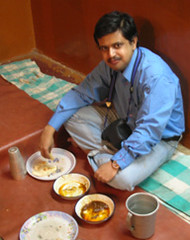 Haji Noora’s nihari shop is not a “family-oriented” place. If you take your aged relatives along, or indeed Abhik, their joints will protest as they are forced to squat on the dari on the ground. An arrangement lacking tables, however, is only a favour to the teeming nihari connoiseurs who land up at the crack of dawn at Haji Noora’s door — how else could so many fit into so small a space? Nor is this shop one to take bosses from your “reputable multinational” (as many a desi orkutter proudly calls his slave-drivers) — they are likely to balk at the sight of less than spic-and-span seating places. Which is just as well, because only the discerning foodie whose tastebuds and nose reign supreme deserves to partake of the food concocted by Haji Noora’s son and heir.
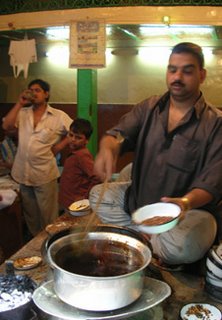 The nihari was quite literally, sublime. Spicy, as good nihari ought to be, it seemed to turn from solid into liquid into a mere scent in your mouth in the blink of an eye. While I haven’t had nihari all my life, having sampled it at Sabri Nihari in Chicago, at Waris in Lahore, and at Karim’s near Jama Masjid just last week, I pretend to some knowledge of what good — nay great — nihari tastes like. I can safely assure you that Haji Noora’s khandani concoction leaves the rest dead in the water. Or in the desi ghee, if you wish. Like all great things, this too was something not much money is needed to buy. Abhik and I polished off three plates of nihari and four tandoori rotis in a matter of minutes, and all of it totted up to fifty rupees. I’ll say no more; you have to go and have it yourself.
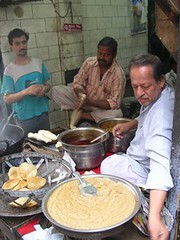 We did follow up the breakfast with some good tea at a nearby shop (Moinuddin tea stall) and some even better sooji-ka-halwa (two plates for ten rupees!) at another nameless breakfast shop owned by a certain Mohd. Zaheer sa’ab. Satisfying as they may have been, their memories are already fading behind those of the nihari. So wake early on the morrow my friend, and hasten to Bara Hindu Rao! For as Kabir had said, surely after a mouthful at Haji Noora’s ancestral haven, “jo sovat hai, so khovat hai”!
Location: The Bara Hindu Rao area is a five minute cycle-rickshaw ride from the Pul Bangash metro station. You will need to ask around for the shop once you get there. Alternatively, take a look at our Google Map!
Timings: about 6:30am to 8:30am and 5pm to 7pm everyday. Remains closed for about 3 days after Eid-ul-Fitr and about 8-10 days after Eid-ul-Adha (Bakri Eid).
Prices: It is difficult to spend more then Rs. 35 per person for a meal. [updated March 22, 2009]
Further to my comments, if any of Nahari lovers wishes to contact me about dishes from Delhi, not at all, I would be delighted to explain. I am hoping to be there by the middle or end of October.
You wrote that the meat, traditionally, should be of cow leg with the bone and slow cooked …
I thought cow was a sacred animal in India…
@long stem red,red rose: India is a diverse country. Some think the cow is sacred, and others think beef is divine 🙂
That said, most beef served in Delhi is actually buffalo meat, due to a ban on cow slaughter enacted by a previous Hindu nationalist government.
I was born and raised in Bara Hindu Rao at 6622 Kothi Mem. Right opposite govt. school on Bahadurgarh Road. Left Bara Hindu Rao in 1977. I was very happy to see Haji Noora’s place on the net. That place was about 3 blocks from my birth place. I was born at home.
I visited Haji Noora yesterday with my family. I have never tasted anything as good as his nihari. The rotis are outstanding and the flavor of the nihari is impeccable. Certainly, one of the best meals consumed by me in Delhi!!! Thanks Himanshu/EOID for introducing the joint. Kallu Nihari next.
For years, having felt like an ‘odd man out’ (if not a straight criminal or an alien) among my circle of family, friends and acquaintances, for having a strong liking for Nahri, it’s a pleasure to have stumbled upon this blog. Heartening to see so many people here, appreciating and actively talking of nahri. As a token of my gratitude, am sharing a list (with some comments) of famous nahri places in Delhi that I and friends have discovered over years.
My sense of gratitude to you all comes from the fact that I have had to listen to lot of criticism for this love of mine. To begin with, being from a conservative, middle class, Hindu traders’ family background, eating beef itself has been a source of dislike and silent social disdain. While no one actively engaged in debate with me for expressing my favor for Nahri, am sure internally, they would tick me off as “not of sound character/values.” And mostly the ground for their dislike is not purely religious. It is also the @/:x&^* dilli wannabe nouveau Punjabi mindset that automatically classifies anything economical as lowbrow…not quality stuff, not healthy etc etc. I don’t get same reactions if I talk of eating tenderloin with black pepper sauce at some 5 star.
Sorry for digressing, here’s coming back to Nahri in Delhi. At the risk of raking a controversy and appearing judgmental, I must say that Haji Noora’s Nahri is by far without comparison in Delhi. In my personal opinion he takes the entire set of honors; first, second and third ranks. All others are way way behind. Thank god that am saying this on Net. At a safe distance from other nahri lovers and loyalists. I couldn’t have made such categorical and emphatic statement standing in say, Matial Mahal or Ballimaran. The risk of getting physically assaulted would have been too high. Nahri and physical threat??!! Whats the fricking connection!!! You would know what am saying, if you speak to some old Delhi food lovers and try to probe their opinion on best Nahri maker in Delhi. Strangely, there is very little consensus on the best Nahri maker in Delhi. And for food enthusiasts of old Delhi, it is a matter of great debate. A hot topic giving rise to lot of zeal, fiery tempers, loyalty and emotional fervor. A loyalty and sense of strong opinions comparable to fan clubs of English Premier League teams like ManU and Chelsea!
Apart from the fan club behind each of the Individual nahri brands like Noore, Shabberati, Zafar etc., there is strong sense of rivalry depending on the area from which the nahari is. The broad areas are Baade ki nahri, Matial Mahal ki Nahri, Nizamuddin ki Nahri and Seelampur ki Nahri. Each of the area residents extol their own version of Nahri and consider others as vastly inferior on the taste and quality scale. So move over the debate whether better Chinese comes from Schezuan, Manchuria or Canton regions. We have our own matters to settle. A sample debate among nahri enthusiasts would go somewhat like this :-
“Aman, ab rehne do. Matia mahal ya bade ki nahri bhi koi nahri hai…shabberati bhi koi nahri banata hai! Ek bar kha lo to pet char din kharab rehta hai. Hamare Nizamuddin ki nahri khao to pata lage ke asli maal kya hota hai”.
“Kya sahab, aap bhi…asli hakimi nuskhe ki nahri ab sirf bade mein hi banti hai. Baki sab bakwas hai. Aapke Nizamuddin ki Nahri to aisa lagta hai ki jaise aate se bhari ho. Huh…char masale daal ke meat ubaal dene se nahri koi banti hai. Janab, Arab ke shekh log Noore se nahri mangwa ke kahte hain. Hawai Jahaz se parcel jata hai! Jab bhi unke yahan palty hoti hai to direc phoon aata hai Jeddah se…haan!”
And this can go on, with arguments from history, logic, culinary art, customer base, lineage of the nahri maker etc. thrown in the debate. None of the arguments would ever reach consensus and progressively the debate would become more and more bitter and emotional. End would be parting of ways without any agreement on the topic.
Another point of difference among Nahri lovers is whether nahri should be had in the beginning of the serving cycle, middle or the end. As Nahri is cooked once only in bulk for one complete serving cycle serving a few hundred portions, there is difference in what you get depending on whether you take it immediately on opening of the cauldron or from the later servings. As you approach the end through middle, the dish keeps getting thicker and spicier by degrees thus causing variation in taste and texture. And there is equal number of loyalists for all stages; some for the beginning, some middle and some preferring the bottom of the cauldron. So we have the complete Left Wing, Right Wing and the Moderates. And then you also have splinter groups with opinions on with/without Ghee, with/without Curd or butter etc etc…Dear Gawd! are we talking of humble Nahri or the Middle East conflict…lolz.
So here is the original promise of the piece, the Hall of Fame for Delhi nahri. And thanks for your patience. If you have managed to read the entire rant and reached up to this point you are a more patient soul than I am
• Haji Noora ki Nahri – talked of extensively on this site.
• Shabberati Ki Nahri – In Chitli Kabar, going from matia Mahal. Its a little ahead of the first intersection. Ask anyone, they all know.
• Kallu Ki Nahri – Article already on this site.
• Hussaini ki Nahri – end of Chitli kabar, Matia Mahal
• Al Madina Nahri – Gali Kasim Jaan (Do visit Ghalib’s Haveli on the way), Ballimaran, Chandni Chowk.
• Al Makka Nahri – A newbie, but quite decent. Much better than the Madina guy who is older and more famous. Gali Kasim Jaan, Ballimaran
• Chashma Building Nahri – Chashma Building, Ballimaran
• Zafar ki Nahri – Zafrabad main road, Seelampur (trans-Yamuna) not worth making a special effort, but do visit if you happen to pass by.
• Hussain ki Nahri – Zafrabad Bazar, Seelampur. Quite nice in my opinion.
• Mounis Kada – Basti Nizamuddin.
Do try as many as possible. There is no one nahri that can be said as best of the lot for everyone. As a Zen master would say, work to find your own god, all other are borrowed gods! You have to work to find your own personal Nahri. You never know which one of them takes you to that ultimate taste that you crave for!!!
Glassbead – that is a fantastic contribution to the nihari cause – hope you’ll join us when we go and check them out!
Pamela – Would be a pleasure to join you all. Am on the blog’s mailing list and will keep a watch for next outing.
Hi Hemanshu, I’m a writer from Malaysia & have written an article on Haji Noora for MSN Malaysia’s soon-to-be-launched travel section. I was inspired by your article & hence, my decision to include it as one of the restaurants to visit when in Delhi. Because photoseof this eatery is hard to come by on the internet (& I presume even harder to request from the owners), I would like to request to use your photos here with your permission. I will be sure to credit you/EOiD accordingly. Would appreciate if you could respond to me via email me. I would be more than happy to explain further & answer any of your queries. Thank you & I look forward to hearing from you very soon!
n here i was thinking that the culture of nihari was dying it is indeed in pakistan because the food prices are reaching new hights people have lost the sense of taste either they want bland or too spicey
belonging to an orignal nihari family even my mother cant cook it that well nowdays a good nihari is rare treat in karachi because the shops have highly fluctuating standards
Muneeb, unfortunately good niharis are very much a rare treat in Delhi as well. It’s only available at Muslim places, and that too just a few of them. On top of that, buff nihari, which I consider superior to mutton nihari, is only available at downmarket places. Haji Noora’s, Kallu and others mentioned on this site are not places where people take their families. It would be safe to say that most of the customers are labourers and some locals who pack it for home.
best in delhi Haji Noora ki Nihari when you try with nalli it gives u different taste
i hope u guys like it. so wake up early mrng.go and try .
After reading about Haji Noora ki Nihari I couldn’t wait to go there.
So, I called 3 of my college friends (jiit college,noida) and we went till tis hazari metro station by car and took a metro to pul bangash metro. From there we took a rickshaw ride to bada hindu rao police station and then walked about half a km to reach a hidden shop which i guess had no name on it but people said it’s the famous Haji noorah ki nihari.
The SHOP: well guys, honestly speaking this was the most downmarket shop I have ever been to. We had to sit on floor and the other customers were drivers or labourers (no offence intended). They were shocked to know that we came from Noida to visit this shop.
The FOOD: anyways, the 4 of us ordered 4 niharis and 2 nalis. The moment I had that nihari, I forgot how the shop looked or how much I had to travel for this, all I remembered at that point of time was the khameeri roti with a spicy nihari melting in my mouth with a taste that was PERFECT .
The COST: Rs 208 only for 4 persons 😀
VERDICT:
Against : Ambience, it’s buffalo meat(i have confirmed it from the sellers),may be too oily for some people (like one of my friends who hated it).
For: Taste and a real nihari experience, Price(does it matter!!!)
Beef is always a matter of speculation across delhi.I was wondering why everyone is so intrigued with cow meat when buffalo is being served over here and that is it…We cant expect more than that
This blog and Glassbead’s comments have stirred an emotion in me that I haven’t felt since my college days. Good job my man!! Now, how the **** am I going to get to Delhi, how will I ever make it to whatever location this place is in, how will find this place…lots of quetions. Maybe I will settle for Sabri in Chicago for now. Surely it isn’t worth flying there from Chicago only for this, is it? NO!!! What am I thinking.
zaidi saheb,mehrwani krke pakki dilhi ke zaike ke ware mein kuch batayaga.,plz..
Just in face anyone has come across this recently and wonders if Haji Noora’s is still kicking: it is. Went this morning. The chai stand at the entrance to the gali after the one for HN (if coming from bara hindu rao road) is delicious – almost worth the trip on its own.
i ate recently at shabrati which is very close to jama masjid (on the saide where karim’s hotel is) and i also ate at haji noor’s. Shabrati was wayyyy wayyy better. I am from hyderabad and a big fan of nihari.
hi…i want know noora is your family name?
im searchin for our origin…we now it since 600 years ago…but not befor…
we think this family maby comes from pakistan india or afghanistan to iran….
do you have family name NOORA…or do u know some of them?
Nihari is a wonderful dish, very popular in Pakistan, people treat it here like national dish.
After reading so many comments about Noora’s nihari i went up there early in the morning (around 6:30.from malviya Nagar) It was good but not as good as you have mentioned. I also had kallu’s nihari before and i think kallu’s nihari is good.
I would also add one more guy in Glassbead’s list that is:
Nikke Nihariwala: Indrachowk, Zafarabaad Bazar, Seelampur
The best nahari I ever tasted and most of the people would agree is that of “Rahim Nahari, Chowk, Lucknow”.
No one can beat that.. Even Glassbead would agree that for any mortals taste bud this will occupy the Best Ever.
The first nihari,
I ever tasted (only 2 months back) was noor mohammadi (bombay)pulled beef ( mahin ghost ) and goonda ( marrow ) nihari, I was late the first day and on the second day I got the thicker biohazard looking stuff at the bottom, while the aromatic flavour ful curry\stew was already gone.
Timing has always been a problem for me when I went out looking for nihari, and i havnt been even lucky enough to get the last in the cauldron stuff since my first tym in bombay.
Be it goledarwaza Lucknow, or nizamuddin basti or jama masjid old Delhi.
all the time I returned without even the scent of nihari.
I live in Karol bagh now just behind the metro station so can somebody please post the nahari timings of these shops Glassbead mentioned, better if someone comes along with me on a good fine day.
Thanx a lot glassbead and hemanshu.
And about cow vs buffallo meat leaving behind the religious issues which one tastes better? My Italian chef/restuarant owning friend tells me goat>sheep is there a difference between cow and bufallo too?
@ Long stem red, red rose and Hemanshu Kumar – Much of the beef in India is buffalo meat not cow! Cow slaughter used to be legal in 2 states, don’t know if it still is. But it’s illegal in Delhi.
Not that the illegal slaughter doesn’t happen, but the most of the beef in circulation is buffalo .